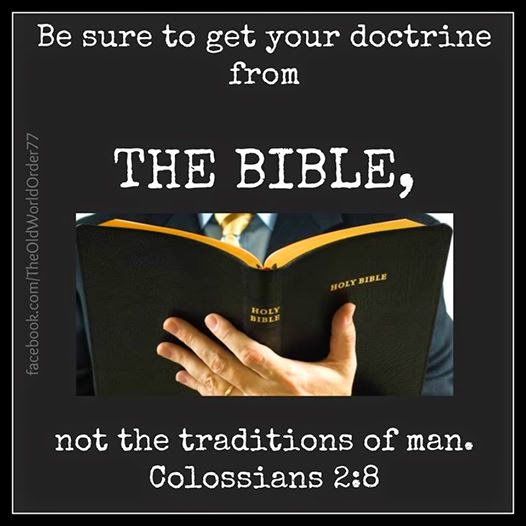
Protestants claim the Bible is the only rule of faith, meaning that it contains all of the material one needs for theology and that this material is sufficiently clear that one does not need apostolic tradition or the Church’s magisterium (teaching authority) to help one understand it. In the Protestant view, the whole of Christian truth is found within the Bible’s pages. Anything extraneous to the Bible is simply non-authoritative, unnecessary, or wrong—and may well hinder one in coming to God.
Catholics, on the other hand, recognize that the Bible does not endorse this view and that, in fact, it is repudiated in Scripture. The true "rule of faith"—as expressed in the Bible itself—is Scripture plus apostolic tradition, as manifested in the living teaching authority of the Catholic Church, to which were entrusted the oral teachings of Jesus and the apostles, along with the authority to interpret Scripture correctly.
In the Second Vatican Council’s document on divine revelation, Dei Verbum (Latin: "The Word of God"), the relationship between Tradition and Scripture is explained: "Hence there exists a close connection and communication between sacred Tradition and sacred Scripture. For both of them, flowing from the same divine wellspring, in a certain way merge into a unity and tend toward the same end. For sacred Scripture is the word of God inasmuch as it is consigned to writing under the inspiration of the divine Spirit. To the successors of the apostles, sacred Tradition hands on in its full purity God’s word, which was entrusted to the apostles by Christ the Lord and the Holy Spirit.
"Thus, by the light of the Spirit of truth, these successors can in their preaching preserve this word of God faithfully, explain it, and make it more widely known. Consequently it is not from sacred Scripture alone that the Church draws her certainty about everything which has been revealed. Therefore both sacred Tradition and sacred Scripture are to be accepted and venerated with the same devotion and reverence."
But Evangelical and Fundamentalist Protestants, who place their confidence in Martin Luther’s theory of sola scriptura (Latin: "Scripture alone"), will usually argue for their position by citing a couple of key verses. The first is this: "These are written that you may believe that Jesus is the Christ, the Son of God, and that believing you may have life in his name" (John 20:31). The other is this: "All Scripture is
inspired by God and profitable for teaching, for reproof, for correction, and for training in righteousness; so that the man of God may be equipped, prepared for every good work" (2 Timothy 3:16–17). According to these Protestants, these verses demonstrate the reality of sola scriptura (the "Bible only" theory).
Not so, reply Catholics. First, the verse from John refers to the things written in that book (read it with John 20:30, the verse immediately before it to see the context of the statement in question). If this verse proved anything, it would not prove the theory of sola scriptura but that the Gospel of John is sufficient.
Second, the verse from John’s Gospel tells us only that the Bible was composed so we can be helped to believe Jesus is the Messiah. It does not say the Bible is all we need for salvation, much less that the Bible is all we need for theology; nor does it say the Bible is even necessary to believe in Christ. After all, the earliest Christians had no New Testament to which they could appeal; they learned from oral, rather than written, instruction. Until relatively recent times, the Bible was inaccessible to most people, either because they could not read or because the printing press had not been invented. All these people learned from oral instruction, passed down, generation to generation, by the Church.
Much the same can be said about 2 Timothy 3:16-17. To say that all inspired writing "has its uses" is one thing; to say that only inspired writing need be followed is something else. Besides, there is a telling argument against claims of Evangelical and Fundamentalist Protestants. John Henry Newman explained it in an 1884 essay entitled "Inspiration in its Relation to Revelation."
Thursday, May 22, 2014
Wednesday, January 9, 2013
Scriptural Apologetics | Catholic Answers
Check out John Martignoni on Catholic Answers Live. He is a wonderful Catholic Apologist, he also runs the Bible Christian Society http://www.biblechristiansociety.com/ Gets information directly from the Bible. Enjoy, visit the link below and click on "Listen" - Courtesy of www.Catholic.com.
Scriptural Apologetics | Catholic Answers
Monday, January 7, 2013
Catholic Answers Live
Check out www.Catholic.com and listen to Catholic Answers Live via your computer. Understand and Learn what the Catholic Church teaches. Advance your knowledge about the Catholic faith and grow in spirituality. Click on the link below Questions and Answers Open Forum for Non-Catholics and Catholics.
http://www.catholic.com/radio/shows/qa-open-forum-6050#
Friday, January 4, 2013
WORD "CATHOLIC"
Check out this video, courtesy of Mr. Jimmy Akin. Video explains the origin of the term or word Catholic, first used. Hope this helps, enjoy the video. Video found on www.Catholic.com.
When was the word "Catholic" first used? | Catholic Answers
THE DIDACHE
THE TEACHING OF THE LORD TO THE GENTILES
BY THE TWELVE APOSTLES
First watch this video link this will explain to you what is a DIDACHE. (The Teaching of the Twelve- an early Christian compilation, written before much of the New Testament)
http://www.catholic.com/video/what-is-the-didache
The Didache is the common name of a brief early Christian treatise (dated by most scholars to the late first/early second century). It is an anonymous work not belonging to any single individual, and a pastoral manual “that reveals more about how Jewish-Christian saw themselves and how they adapted their Judaism for gentiles than any other book in the Christian Scriptures. “The text, part of which may have constituted the first written catechism, has three main sections dealing with Christian lessons, rituals such as baptism and Eucharist, and Church organization. It was considered by some of the Church Fathers as part of the New Testament but rejected as spurious or non-canonical by others, eventually not accepted into the New Testament cannon with the exception of the Ethiopian Orthodox Church “broader canon” which includes the Didascalia which is based on the Didache. The Catholic Church has accepted it as part of the collection of Apostolic Fathers.
1 There are two ways, one of life and one of death, and there is a great difference between
the two ways. 2 The way of life is this. First of all, thou shalt love the God that made
thee; secondly, thy neighbor as thyself. And all things whatsoever thou wouldst not have
befal thyself, neither do thou unto another. 3 Now of these words the doctrine is this. Bless
them that curse you, and pray for your enemies and fast for them that persecute you; for what
thank is it, if ye love them that love you? Do not even the Gentiles the same? But do ye love
them that hate you, and ye shall not have an enemy. 4 Abstain thou from fleshly and bodily
lusts. If any man give thee a blow on thy right cheek, turn to him the other also, and thou
shalt be perfect; if a man impress thee to go with him one mile, go with him twain; if a man
take away thy cloak, give him thy coat also; if a man take away from thee that which is thine
own, ask it not back, for neither art thou able. 5 To every man that asketh of thee give, and
ask not back; for the Father desireth that gifts be given to all from His own bounties. Blessed
is he that giveth according to the commandment; for he is guiltless. Woe to him that
receiveth; for, if a man receiveth having need, he is guiltless; but he that hath no need shall
give satisfaction why and wherefore he received; and being put in confinement he shall be
examined concerning the deeds that he hath done, and he shall not come out thence until he
hath given back the last farthing. 6 Yea, as touching this also it is said; Let thine alms sweat
into thine hands, until thou shalt have learnt to whom to give.
2 And this is the second commandment of the teaching. 2 Thou shalt do no murder, thou
shalt not commit adultery, thou shalt not corrupt boys, thou shalt not commit fornication,
thou shalt not steal , thou shalt not deal in magic, thou shalt do no sorcery, thou shalt not
murder a child by abortion nor kill them when born, thou shalt not covet thy neighbour’s
goods, 3 thou shalt not perjure thyself, thou shalt not bear false witness, thou shalt not speak
evil, thou shalt not cherish a grudge, 4 thou shalt not be double-minded nor double-tongued;
for the double tongue is a snare of death. 5 Thy word shall not be false or empty, but fulfilled
by action. 6 Thou shalt not be avaricious nor a plunderer nor a hypocrite nor ill-tempered nor
proud. Thou shalt not entertain an evil design against thy neighbour. 7 Thou shalt not hate
any man, but some thou shalt reprove, and for others thou shalt pray, and others thou shalt
love more than thy life.
3 My child, flee from every evil and everything that resembleth it. 2 Be not angry, for
anger leadeth to murder, nor jealous nor contentious nor wrathful; for of all these things
murders are engendered. 3 My child, be not lustful, for lust leadeth to fornication, neither
foul-speaking neither with uplifted eyes; for of all these things adulteries are engendered.
4 My child, be no dealer in omens, since it leads to idolatry, nor an enchanter nor an astrologer
nor a magician, neither be willing to look at them; for from all these things idolatry is
engendered. 5 My child, be not a liar, since lying leads to theft, neither avaricious neither
vainglorious; for from all these things thefts are engendered. 6 My child, be not a murmurer,
since it leadeth to blasphemy, neither self-willed neither a thinker of evil thoughts; for from
all these things blasphemies are engendered. 7 But be meek, since the meek shall inherit the
earth. 8 Be long-suffering and pitiful and guileless and quiet and kindly and always fearing
the words which thou hast heard. 9 Thou shalt not exalt thyself, neither shalt thou admit
boldness into thy soul. Thy soul shall not cleave together with the lofty, but with the righteous
and humble shalt thou walk. 10 The accidents that befal thee thou shalt receive as good,
knowing that nothing is done without God.
4 My child, thou shalt remember him that speaketh unto thee the word of God night and
day, and shalt honour him as the Lord; for whencesoever the Lordship speaketh, there is
the Lord. 2 Moreover thou shalt seek out day by day the persons of the saints, that thou
mayest find rest in their words. 3 Thou shalt not make a schism, but thou shalt pacify them
that contend; thou shalt judge righteously, thou shalt not make a difference in a person to
reprove him for transgressions. 4 Thou shalt not doubt whether a thing shall be or not be.
5 Be not thou found holding out thy hands to receive, but drawing them in as to giving.
6 If thou hast ought passing through thy hands, thou shalt give a ransom for thy sins. 7 Thou
shalt not hesitate to give, neither shalt thou murmur when giving; for thou shalt know who is
the good paymaster of thy reward. 8 Thou shalt not turn away from him that is in want, but
shalt make thy brother partaker in all things, and shalt not say that anything is thine own. For
if ye are fellow-partakers in that which is imperishable, how much rather in the things which
are perishable?
9 Thou shalt not withhold thy hand from thy son or from thy daughter, but from their
youth thou shalt teach them the fear of God. 10 Thou shalt not command thy bondservant or
thine handmaid in thy bitterness who trust in the same God as thyself, lest haply they should
cease to fear the God who is over both of you; for He cometh, not to call men with respect of
persons, but He cometh to those whom the Spirit hath prepared. 11 But ye, servants, shall be
subject unto your masters, as to a type of God, in shame and fear. 12 Thou shalt hate all
hypocrisy, and everything that is not pleasing to the Lord. 13 Thou shalt never forsake the
commandments of the Lord; but shalt keep those things which thou hast received, neither
adding to them nor taking away from them. 14 In church thou shalt confess thy transgressions,
and shalt not betake thyself to prayer with an evil conscience. This is the way of life.
5 But the way of death is this. First of all, it is evil and full of a curse; murders, adulteries,
lusts, fornications, thefts, idolatries, magical arts, witchcrafts, plunderings, false
witnessings, hypocrisies, doubleness of heart, treachery, pride, malice, stubbornness, covetousness,
foul-speaking, jealousy, boldness, exaltation, boastfulness; 2 persecutors of good
men, hating truth, loving a lie, not perceiving the reward of righteousness, not cleaving to the
good nor to righteous judgment, wakeful not for that which is good but for that which is evil;
from whom gentleness and forbearance stand aloof; loving vain things, pursuing a recompense,
not pitying the poor man, not toiling for him that is oppressed with toil, not recognizing
Him that made them, murderers of children, corrupters of the creatures of God, turning
away from him that is in want, oppressing him that is afflicted, advocates of the wealthy,
unjust judges of the poor, altogether sinful. May ye be delivered, my children, from all these
things.
6 See lest any man lead you astray from this way of righteousness, for he teacheth thee
apart from God. 2 For if thou art able to bear the whole yoke of the Lord, thou shalt be
perfect; but if thou art not able, do that which thou art able.
3 But concerning eating, bear that which thou art able; yet abstain by all means from
meat sacrificed to idols; for it is the worship of dead gods.
7 But concerning baptism, thus shall ye baptize. Having first recited all these things,
baptize in the name of the Father and of the Son and of the Holy Spirit in living
(running) water. 2 But if thou hast not living water, then baptize in other water; and if thou
art not able in cold, then in warm. 3 But if thou hast neither, then pour water on the head
thrice in the name of the Father and of the Son and of the Holy Spirit. 4 But before the baptism
let him that baptizeth and him that is baptized fast, and any others also who are able; and
thou shalt order him that is baptized to fast a day or two before.
8 And let not your fastings be with the hypocrites, for they fast on the second and the fifth
day of the week; but do ye keep your fast on the fourth and on the preparation (the
sixth) day. 2 Neither pray ye as the hypocrites, but as the Lord commanded in His Gospel,
thus pray ye: Our Father, which art in heaven, hallowed be Thy name; Thy kingdom come;
Thy will be done, as in heaven, so also on earth; give us this day our daily bread; and forgive
us our debt, as we also forgive our debtors; and lead us not into temptation, but deliver us
from the evil one; for Thine is the power and the glory for ever and ever. 3 Three times in the
day pray ye so.
9 But as touching the eucharistic thanksgiving give ye thanks thus. 2 First, as regards the
cup: We give Thee thanks, O our Father, for the holy vine of Thy son David, which
Thou madest known unto us through Thy Son Jesus; Thine is the glory for ever and ever.
3 Then as regarding the broken bread: We give Thee thanks, O our Father, for the life and
knowledge which Thou didst make known unto us through Thy Son Jesus; Thine is the glory
for ever and ever. 4 As this broken bread was scattered upon the mountains and being gathered
together became one, so may Thy Church be gathered together from the ends of the
earth into Thy kingdom; for Thine is the glory and the power through Jesus Christ for ever
and ever. 5 But let no one eat or drink of this eucharistic thanksgiving, but they that have
been baptized into the name of the Lord; for concerning this also the Lord hath said: Give not
that which is holy to the dogs.
10 And after ye are satisfied thus give ye thanks: 2 We give Thee thanks, Holy Father,
for Thy holy name, which Thou hast made to tabernacle in our hearts, and for the
knowledge and faith and immortality, which Thou hast made known unto us through Thy
Son Jesus; Thine is the glory for ever and ever. 3 Thou, Almighty Master, didst create all
things for Thy name's sake, and didst give food and drink unto men for enjoyment, that they
might render thanks to Thee; but didst bestow upon us spiritual food and drink and eternal
life through Thy Son. 4 Before all things we give Thee thanks that Thou art powerful; Thine
is the glory for ever and ever. 5 Remember, Lord, Thy Church to deliver it from all evil and
to perfect it in Thy love; and gather it together from the four winds—even the Church which
has been sanctified—into Thy kingdom which Thou hast prepared for it; for Thine is the
power and the glory for ever and ever. 6 May grace come and may this world pass away.
Hosanna to the God of David. If any man is holy, let him come; if any man is not, let him
repent. Maran Atha. Amen.
7 But permit the prophets to offer thanksgiving as much as they desire.
11 Whosoever therefore shall come and teach you all these things that have been said
before, receive him; 2 but if the teacher himself be perverted and teach a different
doctrine to the destruction thereof, hear him not; but if to the increase of righteousness and
the knowledge of the Lord, receive him as the Lord.
3 But concerning the apostles and prophets, so do ye according to the ordinance of the
Gospel. 4 Let every apostle, when he cometh to you, be received as the Lord; 5 but he shall
not abide more than a single day, or if there be need, a second likewise; but if he abide three
days, he is a false prophet. 6 And when he departeth let the apostle receive nothing save
bread, until he findeth shelter; but if he ask money, he is a false prophet. 7 And any prophet
speaking in the Spirit ye shall not try neither discern; for every sin shall be forgiven, but this
sin shall not be forgiven. 8 Yet not every one that speaketh in the Spirit is a prophet, but only
if he have the ways of the Lord. From his ways therefore the false prophet and the prophet
shall be recognized. 9 And no prophet when he ordereth a table in the Spirit shall eat of it;
otherwise he is a false prophet. 10 And every prophet teaching the truth, if he doeth not what
he teacheth, is a false prophet. 11 And every prophet approved and found true, if he doeth
ought as an outward mystery typical of the Church, and yet teacheth you not to do all that he
himself doeth, shall not be judged before you; he hath his judgment in the presence of God;
for in like manner also did the prophets of old time. 12 And whosoever shall say in the Spirit,
Give me silver or anything else, ye shall not listen to him; but if he tell you to give on behalf
of others that are in want, let no man judge him.
12 But let every one that cometh in the name of the Lord be received; and then when
ye have tested him ye shall know him, for ye shall have understanding on the right
hand and on the left. 2 If the comer is a traveler, assist him, so far as ye are able; but he shall
not stay with you more than two or three days, if it be necessary. 3 But if he wishes to settle
with you, being a craftsman, let him work for and eat his bread. 4 But if he has no craft,
according to your wisdom provide how he shall live as a Christian among you, but not in
idleness. 5 If he will not do this, he is trafficking upon Christ. Beware of such men.
13 But every true prophet desiring to settle among you is worthy of his food. 2 In like
manner a true teacher is also worthy, like the workman, of his food. 3 Every
firstfruit then of the produce of the wine-vat and of the threshing-floor, of thy oxen and of thy
sheep, thou shalt take and give as the firstfruit to the prophets; for they are your chief-priests.
4 But if ye have not a prophet, give them to the poor. 5 If thou makest bread, take the firstfruit
and give according to the commandment. 6 In like manner, when thou openest a jar of wine
or of oil, take the firstfruit and give to the prophets; 7 yea and of money and raiment and
every possession take the firstfruit, as shall seem good to thee, and give according to the
commandment.
14 And on the Lord’s own day gather yourselves together and break bread and give
thanks, first confessing your transgressions, that your sacrifice may be pure. 2 And
let no man, having his dispute with his fellow, join your assembly until they have been reconciled,
that your sacrifice may not be defiled; 3 for this sacrifice it is that was spoken of by
the Lord; In every place and at every time offer Me a pure sacrifice; for I am a great king,
saith the Lord, and My name is wonderful among the nations.
15 Appoint for yourselves therefore bishops and deacons worthy of the Lord, men who
are meek and not lovers of money, and true and approved; for unto you they also
perform the service of the prophets and teachers. 2 Therefore despise them not; for they are
your honourable men along with the prophets and teachers.
3 And reprove one another, not in anger but in peace, as ye find in the Gospel; and let
no one speak to any that has gone wrong towards his neighbor, neither let him hear a word
from you, until he repent. 4 But your prayers and your almsgiving and all your deeds so do
ye as ye find it in the Gospel of our Lord.
16 Be watchful for your life; let your lamps not be quenched and your loins not
ungirded, but be ye ready; for ye know not the hour in which our Lord cometh.
2 And ye shall gather yourselves together frequently, seeking what is fitting for your souls;
for the whole time of your faith shall not profit you, if ye be not perfected at the last season.
3 For in the last days the false prophets and corrupters shall be multiplied, and the sheep shall
be turned into wolves, and love shall be turned into hate. 4 For as lawlessness increaseth,
they shall hate one another and shall persecute and betray. And then the world-deceiver shall
appear as a son of God; and shall work signs and wonders, and the earth shall be delivered
into his hands; and he shall do unholy things, which have never been since the world began.
5 Then all created mankind shall come to the fire of testing, and many shall be offended and
perish; but they that endure in their faith shall be saved by the Curse Himself. 6 And then
shall the signs of the truth appear; first a sign of a rift in the heaven, then a sign of a voice of
a trumpet, and thirdly a resurrection of the dead; 7 yet not of all, but as it was said: The Lord
shall come and all His saints with Him. 8 Then shall the world see the Lord coming upon the
clouds of heaven. Reference: Translated and edited by J. B. Lightfoot Formate by DIBS
Did the Emperor Constantine found the Catholic Church? | Catholic Answers
Found this video on Catholic Answers by a very renowned Apologetic Mr. Jimmy Akin. I hope you enjoy and learn from this video as I have....
Did the Emperor Constantine found the Catholic Church? | Catholic Answers
KEPHA
"And when he [Jesus] had said this, he breathed on them [Apostles] and said to them [Apostles], “Receive the holy Spirit. Whose [sinners] sins you forgive are forgiven them, and whose sins you retain are retained.” John chapter 20 verse 22-23
Question: If Jesus gave the Apostles the authority to forgive sins, then do you think the authority ended after the last Apostle died somewhere in 60 AD and did the Church that Jesus founded seize to exist?
Jesus started a Church during 30-33 AD, somewhere during the time as it state in the Bible. Was the Church supposed to stop functioning after Jesus left for Heaven? ~And so I say to you, you are Peter, and upon this rock I will build my church,* and the gates of the netherworld shall not prevail against it. Matthew Chapter 16 verse 18.
Think about it, “gates of netherworld shall not prevail against it” until your death Peter; NO till the end of time – Amazing isn’t it. Jesus was preparing and building his Church for generations to come after Peter and the first eleven.
Another thing that I found interesting most argue that Peter was not the rock that Jesus was referring too. Here’s the problem with the argument, in Matthew Chapter 16 Jesus bestows blessing upon Peter before and after he hand him the authority here on earth. See below:
First Blessing:
Simon Peter said in reply, “You are the Messiah, the Son of the living God.” 17Jesus said to him in reply, “Blessed are you, Simon son of Jonah. For flesh and blood* has not revealed this to you, but my heavenly Father. Matthew Chapter 16 verse 16-17
Second Blessing:
I will give you the keys to the kingdom of heaven.* Whatever you bind on earth shall be bound in heaven; and whatever you loose on earth shall be loosed in heaven.” Matthew Chapter 16 verse 19.
Give you the Key to the Kingdom of heaven - another blessing.
Now, what I am confused about is that why after Jesus gave Peter blessing upon blessing and authority. Jesus would call Peter “a small rock” or a pebble as it is mostly argued in other Christian circles. Some argue that in this passage there is a minor difference between the Greek term for Peter (Petros) and the term for rock (petra), yet they ignore the obvious explanation: petra, a feminine noun, has simply been modified to have a masculine ending, since one would not refer to a man (Peter) as feminine. The change in the gender is purely for stylistic reasons. (Catholic.com~Origins of Peter as Pope)
These critics also neglect the fact that Jesus spoke Aramaic, and, as John 1:42 tells us, in everyday life he actually referred to Peter as Kepha or Cephas (depending on how it is transliterated). It is that term which is then translated into Greek as petros. Thus, what Jesus actually said to Peter in Aramaic was: "You are Kepha and on this very kepha I will build my Church." (Catholic.com~Origins of Peter as Pope)
The idea behind writing this article and the research is not to prove who is right or wrong. But, I would like my followers, readers to understand the teachings logically that Jesus’ Church was not limited to the 12 twelve Apostle, he did not bestow authority because he felt like, there was a purpose. Jesus was building a unit on earth through these Apostles for the generations to come, that these Apostles would preach, teach, lead and develop succession; pass on traditions and oral teaching to the ones they ordain giving their successors the authority to forgive sin in the name of Christ and for that reason the CHURCH has prevailed against the gates of Hades for 2000 years, since its commencement by Jesus in the year 30 AD.
Additional ExplanationYou are Peter, and upon this rock I will build my church: the Aramaic word kēpā’ meaning rock and transliterated into Greek as CĒphas is the name by which Peter is called in the Pauline letters (1 Cor 1:12; 3:22; 9:5; 15:4; Gal 1:18; 2:9, 11, 14) except in Gal 2:7–8 (“Peter”). It is translated as Petros (“Peter”) in Jn 1:42. The presumed original Aramaic of Jesus’ statement would have been, in English, “You are the Rock (Kēpā’) and upon this rock (kēpā’) I will build my church.” The Greek text probably means the same, for the difference in gender between the masculine noun petros, the disciple’s new name, and the feminine noun petra (rock) may be due simply to the unsuitability of using a feminine noun as the proper name of a male. Although the two words were generally used with slightly different nuances, they were also used interchangeably with the same meaning, “rock.” Church: this word (Greek ekklēsia) occurs in the gospels only here and in Mt 18:17 (twice). There are several possibilities for an Aramaic original. Jesus’ church means the community that he will gather and that, like a building, will have Peter as its solid foundation. That function of Peter consists in his being witness to Jesus as the Messiah, the Son of the living God. The gates of the netherworld shall not prevail against it: the netherworld (Greek Hadēs, the abode of the dead) is conceived of as a walled city whose gates will not close in upon the church of Jesus, i.e., it will not be overcome by the power of death.
* [16:19] The keys to the kingdom of heaven: the image of the keys is probably drawn from Is 22:15–25 where Eliakim, who succeeds Shebnah as master of the palace, is given “the key of the house of David,” which he authoritatively “opens” and “shuts” (Mt 22:22). Whatever you bind…loosed in heaven: there are many instances in rabbinic literature of the binding-loosing imagery. Of the several meanings given there to the metaphor, two are of special importance here: the giving of authoritative teaching, and the lifting or imposing of the ban of excommunication. It is disputed whether the image of the keys and that of binding and loosing are different metaphors meaning the same thing. In any case, the promise of the keys is given to Peter alone. In Mt 18:18 all the disciples are given the power of binding and loosing, but the context of that verse suggests that there the power of excommunication alone is intended. That the keys are those to the kingdom of heaven and that Peter’s exercise of authority in the church on earth will be confirmed in heaven show an intimate connection between, but not an identification of, the church and the kingdom of heaven (http://www.usccb.org/bible/matthew/16)
Reference:
NIHIL OBSTAT: I have concluded that the materials
presented in this work are free of doctrinal or moral errors.
Bernadeane Carr, STL, Censor Librorum, August 10, 2004
Websites: http://www.usccb.org/bible/matthew/16
http://www.catholic.com/tracts/origins-of-peter-as-pope
Friday, December 21, 2012
Everything God Created Is Good
Another Pauline passage sometimes offered as a challenge to Catholicism is the following:
Now the Spirit expressly says that in later times some will depart from the faith by giving heed to deceitful spirits and doctrines of demons, through the pretensions of liars whose consciences are seared, who forbid marriage and enjoin abstinence from foods which God created to be received with thanksgiving by those who believe and know the truth. For everything created by God is good, and nothing is to be rejected if it is received with thanksgiving; for then it is consecrated by the word of God and prayer. (1 Tm 4:1-5)
The claim is that Paul today would oppose the Catholic practices of a celibate priesthood—said to "forbid marriage"—and Lenten fasting and abstinence. These disciplines are described as, in Paul’s own words, "doctrines of demons."
Again, though, understood in proper historical context, we find that Paul was not referring to Catholic disciplines at all. Rather, he was speaking about Gnosticism, which opposed anything material and forbade marriage among its followers. And the Jewish faith’s dietary laws required complete abstinence from certain "unclean" foods. Paul opposed these doctrines.
In contrast, however, Paul embraced the Catholic disciplines of priestly celibacy and sacrificial abstinence (i.e. forgoing a good for a greater purpose). Consider these passages related to celibacy:
- To the unmarried and the widows I say that it is well for them to remain single as I do (1 Cor 7:8).
- I want you to be free from anxieties. The unmarried man is anxious about the affairs of the Lord, how to please the Lord; but the married man is anxious about worldly affairs, how to please his wife, and his interests are divided. And the unmarried woman or girl is anxious about the affairs of the Lord, how to be holy in body and spirit; but the married woman is anxious about worldly affairs, how to please her husband. I say this for your own benefit, not to lay any restraint upon you, but to promote good order and to secure your undivided devotion to the Lord . . . [H]e who marries his betrothed does well; and he who refrains from marriage will do better. A wife is bound to her husband as long as he lives. If the husband dies, she is free to be married to whom she wishes, only in the Lord. But in my judgment she is happier if she remains as she is (1 Cor 7:32-35, 38-40).
Also, recall Acts 14:23 (quoted above) in which Paul commends fasting: "[W]ith prayer and fasting they committed them to the Lord in whom they believed" (Acts 14:23).
These passages alone leave little doubt that Paul would approve of today’s Catholic disciplines of priestly celibacy and Lenten fasting and abstinence.
Reference: Catholic.com (This Article was taken from Catholic.com. No changes have been made to the text; it’s in the original format to preserve the explanation and integrity of the document. Written by a professional staff Apologist from Catholic Answers Live. I personally do not take credit for writing this article.)
SHRINES MADE BY MAN
In the Acts of the Apostles, Paul proclaims, "The God who made the world and everything in it, being Lord of heaven and earth, does not live in shrines made by man, nor is he served by human hands, as though he needed anything, since he himself gives to all men life and breath and everything" (17:24-25).
Non-Catholics sometimes quote this passage to refute Catholic teachings on the Real Presence of Christ in the Eucharist and the sacramental priesthood. Since the Eucharist is reserved in tabernacles and worshipped by the Catholic faithful, Catholics are said to be in conflict with Paul’s teaching that God "does not live in shrines made by man." The sacramental priesthood is said to be unbiblical, as God is not "served by human hands." The claim goes that Paul’s words oppose related Catholic teaching and practice.
Of course, understood in its proper context, this passage addresses neither tabernacles nor Catholic priests. On Paul’s second missionary journey, he traveled to Athens, where the pagans worshipped multiple gods. Even today, pagan temples and ruins can be found throughout much of the city. In Paul’s day, a site just below the Acropolis served as a type of court—the Areopagus. Paul had been preaching in the local synagogues and marketplace before he was brought to the Areopagus to explain his teaching. There in the Pagan temples and shrines, his words in Acts were significant to those pagan worshippers who with their human hands served the false gods who heard them.
In fact, Paul was not condemning Catholic tabernacles and priests. His belief in the Real Presence and the priesthood are evident elsewhere in his writings. For example, Paul could only have in mind the Real Presence when he asked, "The cup of blessing which we bless, is it not a participation in the blood of Christ? The bread which we break, is it not a participation in the body of Christ?" (1 Cor 10:16).
Also consider, "Whoever, therefore, eats the bread or drinks the cup of the Lord in an unworthy manner will be guilty of profaning the body and blood of the Lord. Let a man examine himself . . . For anyone who eats and drinks without discerning the body eats and drinks judgment upon himself" (1 Cor 11:27-29).
As for the sacramental priesthood, Luke attested to Paul’s Catholic belief in Acts:
[Paul and Barnabas] returned to Lystra and to Iconium and to Antioch, strengthening the souls of the disciples, exhorting them to continue in the faith, and saying that through many tribulations we must enter the kingdom of God. And when they had appointed elders for them in every church, with prayer and fasting they committed them to the Lord in whom they believed. (Acts 14:21-23, emphasis added)
Elders here is translated from the Greek word presbyterous, from which we get the English word "presbyter," the official name of the office of Catholic priest.
Paul expected Titus (and others) to do likewise: "This is why I left you in Crete, that you might amend what was defective, and appoint elders in every town as I directed you" (Ti 1:5).
Reference: Catholic.com (This Article was taken from Catholic.com. No changes have been made to the text; it’s in the original format to preserve the explanation and integrity of the document. Written by a professional staff Apologist from Catholic Answers Live. I personally do not take credit for writing this article.)
UNCLEAN FOOD
When writing to the Romans, Paul speaks of a delicate pastoral situation in the first-century Church. There were many Jewish Christians who still believed that certain foods were unclean or otherwise forbidden (e.g., much of the meat sold in Gentile markets had been sacrificed to idols). Paul explained that none of these foods were really unclean or forbidden, but stressed that his readers should not do things that would tempt people into eating these foods if it would violate their consciences:
Then let us no more pass judgment on one another, but rather decide never to put a stumbling block or hindrance in the way of a brother. I know and am persuaded in the Lord Jesus that nothing is unclean in itself; but it is unclean for anyone who thinks it unclean. If your brother is being injured by what you eat, you are no longer walking in love. Do not let what you eat cause the ruin of one for whom Christ died. (Rom 14:13–15)
The mortal consequences of sinning in this way are clear. Paul speaks of an individual being “destroyed” by violating his conscience in this way: “Do not, for the sake of food, destroy the work of God. Everything is indeed clean, but it is wrong for anyone to make others fall by what he eats” (Rom 14:20). “But he who has doubts is condemned, if he eats, because he does not act from belief [i.e., in accord with his beliefs or conscience]; for whatever does not proceed from belief is sin” (Rom 14:23).
Leviticus Chapter 17 verse 14.
Since the life of all flesh is its blood. I have told the Israelites: You shall not consume the blood of any flesh. Since the life of all flesh is its blood, anyone who consumes it shall be cut off. Lev 17:14
Again, let’s read the text in context. This law was given to the Jewish people and aliens Not Christians yet. Because Jesus our messiah was not sent yet.
You shall eat no blood whatever, whether of fowl or of animal, in any of your dwellings. Whoever eats any blood, that person shall be cut off from his people (Lv 7:26-27).
For the life of every creature is the blood of it; therefore I have said to the people of Israel, You shall not eat the blood of any creature, for the life of every creature is its blood; whoever eats it shall be cut off (Lv 17:14).
• You can say four things. First, any divine command that comes later modifies divine commands that came earlier. When Jesus declared all foods clean (Mk 7:19), his command superseded the earlier command that certain foods be regarded as unclean (Lv 11:1-8). If Jesus today commands us to drink his blood, his command supersedes any prior command concerning drinking blood.
• Second, the command against drinking blood, like all of the Old Testament dietary regulations, has passed away, for "These are only a shadow of what is to come, but the substance belongs to Christ. Therefore let no one pass judgment on you in questions of food and drink" (Col 2:17, 16).
• The mention of not eating blood in Acts 15:20, 29 was a pastoral provision suggested by James to keep Jews from being scandalized by the conduct of Gentile Christians. We know that these pastoral provisions were only temporary. One concerned abstaining from idol meat, yet later Paul says eating idol meat is okay so long as it doesn't scandalize others (Rom 14:1-14, 1 Cor 8:1-13).
• If it is objected that blood is not a food (though it is in some cultures), note that Jesus was asked (Mk 7:5) why his disciples ate with unwashed hands. He replied, "Don't you see that nothing that enters a man from the outside can make him unclean? For it doesn't go into his heart but into his stomach, and then out of his body" (7:18-19). In context this refers to a non-food substance (the dirt on one's unwashed hands).
• Third, the Old Testament is very specific about why one was not to eat blood: "The life of every creature is the blood of it; therefore I have said to the people of Israel, You shall not eat the blood of any creature, for the life of every creature is its blood" (Lv 17:14, cf. Dt 12:23). The Israelites could not eat animal blood because it contained the animal's life, but there is one Person whose life you must have in you, "Christ who is your life" (Col 3:4).
Reference: Catholic.com
VENIAL OR MORTAL SIN – “SIN IS SIN”
Venial sin becomes mortal because a person ignores his conscience and commits a sin that violates his conscience in a grave way. Cutting yourself off from sanctifying grace and greatly offending God (Catholic.com)
Under the heading “Erroneous Judgment,” the Catechism states, “A human being must always obey the certain judgment of his conscience. If he were deliberately to act against it, he would condemn himself. Yet it can happen that moral conscience remains in ignorance and makes erroneous judgments about acts to be performed or already committed” (1790).
Wednesday, December 19, 2012
GRAVEN IMAGES
“You Shall Not Make for Yourself a Graven Image...”
What does that really mean? Let’s see what the Catechism has to say about Graven Images in Catholic Churches.
Holy images Catechsim 476-477, 1159-1162, 2129-2132
476 Since the Word became flesh in assuming a true humanity, Christ’s body was finite.112 Therefore the human face of Jesus can be portrayed; at the seventh ecumenical council (Nicaea II in 787) the Church recognized its representation in holy images to be legitimate.113 (1159-1162, 2129-2132)
477 At the same time the Church has always acknowledged that in the body of Jesus “we see our God made visible and so are caught up in love of the God we cannot see.”114 The individual characteristics of Christ’s body express the divine person of God’s Son. He has made the features of his human body his own, to the point that they can be venerated when portrayed in a holy image, for the believer “who venerates the icon is venerating in it the person of the one depicted.”115
1159 The sacred image, the liturgical icon, principally represents Christ. It cannot represent the invisible and incomprehensible God, but the incarnation of the Son of God has ushered in a new “economy” of images:
Previously God, who has neither a body nor a face, absolutely could not be represented by an image. But now that he has made himself visible in the flesh and has lived with men, I can make an image of what I have seen of God... and contemplate the glory of the Lord, his face unveiled.27
1160 Christian iconography expresses in images the same Gospel message that Scripture communicates by words. Image and word illuminate each other:
We declare that we preserve intact all the written and unwritten traditions of the Church which have been entrusted to us. One of these traditions consists in the production of representational artwork, which accords with the history of the preaching of the Gospel. For it confirms that the incarnation of the Word of God was real and not imaginary, and to our benefit as well, for realities that illustrate each other undoubtedly reflect each other’s meaning.28
1161 All the signs in the liturgical celebrations are related to Christ: as are sacred images of the holy Mother of God and of the saints as well. They truly signify Christ, who is glorified in them. They make manifest the “cloud of witnesses”29 who continue to participate in the salvation of the world and to whom we are united, above all in sacramental celebrations. Through their icons, it is man “in the image of God,” finally transfigured “into his likeness,”30 who is revealed to our faith. So too are the angels, who also are recapitulated in Christ:
Following the divinely inspired teaching of our holy Fathers and the tradition of the Catholic Church (for we know that this tradition comes from the Holy Spirit who dwells in her) we rightly define with full certainty and correctness that, like the figure of the precious and life-giving cross, venerable and holy images of our Lord and God and Savior, Jesus Christ, our inviolate Lady, the holy Mother of God, and the venerated angels, all the saints and the just, whether painted or made of mosaic or another suitable material, are to be exhibited in the holy churches of God, on sacred vessels and vestments, walls and panels, in houses and on streets.31
1162 “The beauty of the images moves me to contemplation, as a meadow delights the eyes and subtly infuses the soul with the glory of God.”32 Similarly, the contemplation of sacred icons, united with meditation on the Word of God and the singing of liturgical hymns, enters into the harmony of the signs of celebration so that the mystery celebrated is imprinted in the heart’s memory and is then expressed in the new life of the faithful. (2502)
2129 The divine injunction included the prohibition of every representation of God by the hand of man. Deuteronomy explains: “Since you saw no form on the day that the LORD spoke to you at Horeb out of the midst of the fire, beware lest you act corruptly by making a graven image for yourselves, in the form of any figure....”66 It is the absolutely transcendent God who revealed himself to Israel. “He is the all,” but at the same time “he is greater than all his works.”67 He is “the author of beauty.”68 (300, 2500)
2130 Nevertheless, already in the Old Testament, God ordained or permitted the making of images that pointed symbolically toward salvation by the incarnate Word: so it was with the bronze serpent, the ark of the covenant, and the cherubim.69
2131 Basing itself on the mystery of the incarnate Word, the seventh ecumenical council at Nicaea (787) justified against the iconoclasts the veneration of icons—of Christ, but also of the Mother of God, the angels, and all the saints. By becoming incarnate, the Son of God introduced a new “economy” of images. (476)
2132 The Christian veneration of images is not contrary to the first commandment which proscribes idols. Indeed, “the honor rendered to an image passes to its prototype,” and “whoever venerates an image venerates the person portrayed in it.”70 The honor paid to sacred images is a “respectful veneration,” not the adoration due to God alone:
Religious worship is not directed to images in themselves, considered as mere things, but under their distinctive aspect as images leading us on to God incarnate. The movement toward the image does not terminate in it as image, but tends toward that whose image it is.
Tuesday, December 20, 2011
MARY IN THE BIBLE
For a full track, please visit www.biblechristiansociety.com
Speaker: John Martignoni
Wednesday, December 7, 2011
Sola Scriptura - The Bible Alone?
Visit: www.BibleChristianSociety.com to download full talk(s)
Such as Mary in the Bible, Purgatory and Rapture
Courtesy: John Martignoni - Speaker
Such as Mary in the Bible, Purgatory and Rapture
Courtesy: John Martignoni - Speaker
Subscribe to:
Posts (Atom)